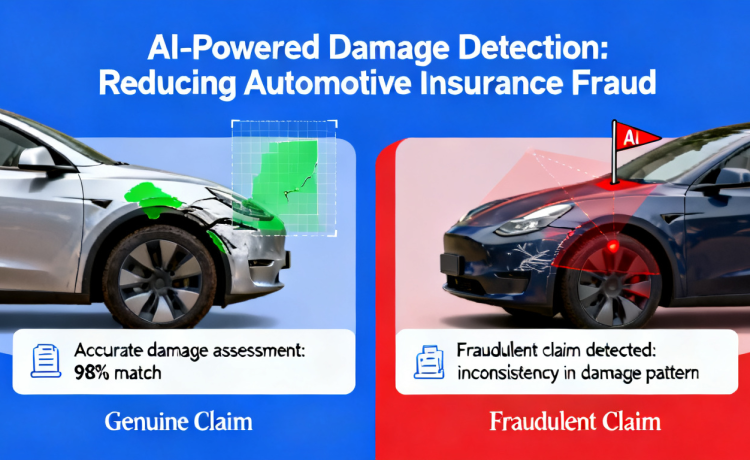
Insurance fraud leads to a higher cost for the automotive insurance industry, and it can go up to billions of dollars annually, with figures suggesting that fraudulent claims account for 10-15% of total claim payouts. These losses don’t just hurt insurance companies – they translate directly into higher premiums for honest policyholders who end up bearing the financial burden of fraudulent activity.
AI damage detection in auto insurance is changing this dynamic by shifting fraud prevention from reactive investigation to proactive detection. By analyzing vehicle damage imagery with computer vision and machine learning, AI systems identify fraudulent claims during initial submission before any payments occur. This technological shift represents one of the most significant advances in insurance fraud prevention in decades.

Understanding Insurance Fraud in Automotive Claims
Insurance fraud in automotive claims takes many forms, from opportunistic individual attempts to sophisticated organized operations. The spectrum ranges from mild exaggeration of legitimate damage to completely fabricated claims involving vehicles that were never actually damaged.
The problem grows more sophisticated as technology makes fraud easier to execute. Photo editing software helps make it possible for convincing damage manipulation. Online forums have a wide range of fraud techniques that are shared. Organized rings harmonize schemes across multiple participants and insurance companies. What once needed specialized knowledge now happens through widely available tools and information.
Common Fraud Schemes in Auto Insurance
Staged Accidents
Staged accidents involve intentionally causing collisions to make it possible to gain insurance claims. Fraudsters might suddenly break in front of victims, get witnesses to support false narratives and incidents, or get in touch and organize multi-vehicle scenarios that look like they are accidental but follow planned scripts.
These schemes often focus on the commercial vehicles or drivers perceived as unlikely to dispute claims vigorously. The financial payoff can be a lot when claims involve not just vehicle damage but also injury compensation and rental reimbursement.
Exaggerated Damage Claims
Exaggerated claims start with legitimate accidents but inflate damage severity or repair costs beyond actual requirements. A minor fender scrape becomes a major panel damage that needs replacement. Small dents get shown as structural issues that need major bodywork.
This fraud type is possible because some real damage exists, making the overstatement harder to detect than completely false claims. Insurers find it difficult to prove that the claimed damage is more than the actual impact when both parties acknowledge an incident occurred.

Reused or Manipulated Photos
Photo fraud involves submitting images that don’t actually represent current vehicle damage. Fraudsters might use the photos again and again from actual past damage, download images from online sources, or digitally manipulate pictures to add or enhance damage appearance.
This scheme exploits the fact that manual photo review can’t verify image authenticity beyond obvious inconsistencies.
Pre-Existing Damage Claimed as New
This fraud involves claiming that damage existed before a claimed incident occurred during that specific event. Someone with vehicle damage who already had plans a minor accident, then files a claim attributing all damage to the recent incident rather than focusing on the pre-existing conditions.
Detection requires comparing vehicle conditions before and after claimed incidents. Without baseline documentation, insurers find it very difficult to prove damage existed previously, especially when a major amount of time has passed since policy inception.
How AI-Powered Damage Detection Works
Computer Vision Technology
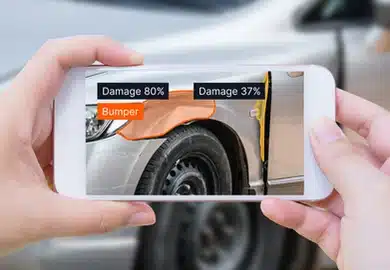
Computer vision makes it possible for AI systems to “see” and study vehicle damage imagery similarly to how human eyes work but with capabilities that are much better than the human performance. The technology studies photos at pixel level, catching damage characteristics, vehicle features, and image properties invisible to manual review.
Training on millions of damage examples teaches computer vision models what real damage looks like for different vehicles, lighting conditions, and damage types. This in-depth training makes systems that recognize actual damage patterns while flagging anomalies suggesting fraud.
Image Authenticity Verification
AI systems study photo authenticity through many analytical approaches. Metadata analysis checks when and where photos were taken. Compression artifact examination gives the results of whether images have been edited. Lighting analysis makes sure that there is consistency across many photos supposedly taken during the same session.
These technical checks happen automatically during claim submission, verifying that submitted imagery actually shows the current vehicle condition instead of recycled, downloaded, or manipulated content.
Historical Data Comparison
AI systems maintain databases of inspections that have happened before, claims, and damage imagery. When new claims arrive, the technology compares submitted photos against historical records to identify reused images or detect pre-existing damage being claimed as new.
This historical comparison happens across insurers when data sharing agreements exist, catching fraudsters who file similar claims with multiple companies using recycled damage imagery.
Key AI Capabilities That Detect Fraud
Photo Manipulation Detection
AI identifies digitally changed images through forensic analysis that studies the image properties at levels imperceptible to human review. The technology catches clone stamp artifacts where damage gets copied from one image area to another.It also catches the inconsistent lighting which shows the composite images. It identifies smoothing patterns indicating airbrushing or digital enhancement.
This capability catches fraud attempts that would easily fool human reviewers examining photos normally without technical analysis tools.
Duplicate Image Identification
AI systems create digital fingerprints of submitted photos, comparing them against databases containing millions of previous claim images. When identical or nearly identical images appear across many claims, the system flags this suspicious pattern at that moment itself.
This detection works even when fraudsters try to disguise reuse by cropping, rotating, or applying filters to images. The underlying image structure remains recognizable to AI analysis even after these cosmetic changes.
Real-World Fraud Detection Applications
First Notice of Loss Verification
When policyholders submit initial claim notices with damage photos, AI quickly studies this imagery for fraud indicators and any signs of that. Photo gets verified, damage patterns get checked and compared to the claimed accident scenarios, and submitted images get compared with the historical databases.
This immediate verification happens within minutes of claim submission, identifying any fake attempts before claims enter processing workflows where they consume resources and can also result in improper payments.
Pre-Policy Inspection Verification
AI systems document baseline vehicle condition when policies start, making permanent records of damage that was there before. This documentation prevents fraud where applicants conceal existing damage during underwriting then file claims attributing that damage to subsequent incidents.
The technology also verifies that submitted pre-policy inspection photos accurately represent vehicles being insured rather than different vehicles in better condition.
Repair Completion Verification
After repairs complete, AI compares pre-repair and post-repair imagery to verify that claimed repairs actually occurred and were performed as specified. This prevents fraud where policyholders receive repair payments but don’t complete work or where repair costs get claimed but services aren’t actually provided.
Benefits Beyond Fraud Prevention
Faster Legitimate Claim Processing
Automated verification allows actual claims to move through processing quickly without manual fraud review delays. When AI confirms the claim of how real it actually is, approvals happen on the spot instead of waiting for the completion of the investigation.
This speed improvement helps with customer satisfaction for honest policyholders while preventing fraud, creating much better experiences without actually hindering the security.
Reduced Investigation Costs
By identifying high-risk claims automatically, AI focuses investigation resources on genuinely suspicious cases instead of needing broad manual review. This targeted approach lessens investigation costs while improving detection effectiveness through better resource allocation.
Investigators spend time on complex fraud requiring human judgment rather than checking obvious cases that AI handles automatically.
Improved Customer Trust
Transparent AI-based fraud detection builds trust with honest customers who see that insurers actively prevent fraud that would otherwise increase their premiums. Clear communication about fraud prevention measures demonstrates insurer commitment to protecting policyholders from bearing costs of fraudulent activity.
Implementation Considerations
Integration with Existing Systems
AI tools must connect smoothly with claim management platforms, enabling automated data flow between systems. Poor integration creates manual work that defeats automation benefits and creates error opportunities through duplicate data entry.
API availability and integration support from AI vendors determine implementation complexity and timeline.
Balancing Automation with Human Oversight
While AI handles most fraud detection automatically, human oversight is one of the most important aspects for complex cases that need judgment. Implementation should define clear criteria for automatic handling versus human review, making sure of appropriate resource allocation.