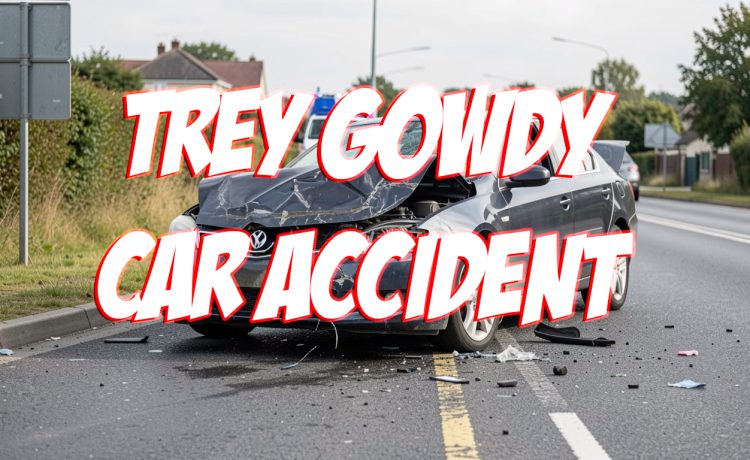
It is like some brutal joke when the headlines are going on about how Trey Gowdy was in a car accident. A man who has spent decades in the spotlight of national examination, arguing, suing, and making the laws, is suddenly a victim of the same everyday ritual that has kept him on the move: driving. The accident that rocked South Carolina last month, referred to as the Trey Gowdy car accident, was much more than a headline; it was a wake-up call that no man is beyond the merciless nature of the road.
The majority of the population believes that it is only the unprepared or the reckless who can experience a minor car overturn or an abrupt slip. The fact is that in combination, the weather, infrastructure, and the reaction of a human being can become a dangerous crash even to the most professional driver. The accident with Trey Gowdy teaches us that a simple drive can be transformed into a life-changing event in just a couple of seconds, and we now reconsider the habits that we are so used to so that they are guaranteed to be safe. The Trey Gowdy car accident serves as a reminder of this reality.
About Trey Gowdy
Trey Gowdy was already a household name prior to the crash that was associated with judicial energy and congressional inquisitions. In 2011, Gowdy was elected to represent the 7 th District of South Carolina in the House of the United States of America, and he served there until 2019. Good experience in the House Oversight and Judiciary committees gave him a reputation as a rough and straightforward investigator when high profile investigations were being conducted. Upon his departure from Congress, he resorted to commentary, providing legal commentary on TV and radio.
The image that Gowdy had crafted publicly was one of wit, straightforward style, and interest in the cause of justice. He was an accountable and transparent man, which could be demonstrated through his career choices that started as a federal prosecutor, then as a politician, and eventually as a media commentator. Thus, when he was caught in an accident, the image was a surprise to numerous viewers: even a disciplined person cannot escape the dangers of the road that he is not familiar with.
The Case of the Trey Gowdy Car Accident: An Impact with the Elements
It was a wet February evening, and Gowdy was riding in his sedan, a modest car, on U.S. Highway 17, which is one of the main north-south routes in South Carolina and which borders the Atlantic Ocean. It had been foggy, and the last rain had deposited spots of ice—the so-called black-ice view of things that are scarcely noticeable to those on the ground.
The police report indicated that the car lost control on a wet road and was moving towards a fixed support structure which was part of the highway safety fence. The car crashed, and Gowdy and one of the passengers were in a delicate situation. Although the car had a contemporary safety system on board, such as airbags, seatbelt pretensioners, and electronic stability control, the collision was so severe that it caused the sedan to tip over.
The event happened at about 9:07 pm, when it is dark and no one can see anything naturally. The lighting on the highway was also inadequate to light up the whole distance, and the fog lowered the visibility to a matter of meters. Even in such conditions, a driving professional is at an increased risk of distance evaluation or inability to respond within a reasonable time.
Speed and Challenges of Emergency Response
The response time of the first emergency vehicles on the scene was 12 minutes, which is a good response period under the circumstances. Paramedics and highway patrol officers rushed to the accident scene: the occupants of the car were tied down, and the front part of the car was badly damaged.
Gowdy was removed using a cervical collar owing to a suspected neck injury whereas the ankle of the passenger was strapped after a comprehensive checkup. One of the passengers was concussed and was observed for some hours and then taken to a local emergency service.
The fog and poor cell signal coverage became a two-tailed issue: it affected the incident remotely, yet communication with the dispatch centers and organization of the work with medical services was slow. The paramedics needed to use radio channels that were partly saturated, which served as a problem in providing more medical assistance.
Even though the hurdles were encountered, the response team was efficient thus minimizing the possibilities of further destruction. The fact that the patients were extracted out of a shaky vehicle promptly and the first-aid treatment was provided in a timely manner contributed greatly to the prevention of secondary injuries.
Medical Results: Major Injuries, Minute Lessons
The wounds Gowdy sustained could be categorized as mild but he had to rest and have physical therapy, as this would ensure that the injury was totally healed. The ankle injury patient was under regular orthopedic care and the patient with a concussion was also provided with a 24 hours follow up as an assurance that he had no delayed symptoms. When the article was published, no reports about long-term damage could be found.
The medical response also pointed to a systemic weakness: fog had slowed down the first emergency call. Although paramedics eventually came in a very short time, delays in prior warning may increase the extent of injury. The event highlights the importance of having well-developed communication networks, like specialized highway-level wireless networks to rural roads.
Witness Testimonies and Social Response
Some of the witnesses have recounted the scene as being strangely silent. One of the passersby said that it seemed as though the entire world had been frozen in time because paramedics had come as they did. The yellow danger signals were bouncing on the fog, and it gave the ruined sedan an almost ethereal look.
Social media was in a rampage, and pictures and brief videos were being shared. Most people complimented the speed of the rescuers, whereas some others criticized the safety capabilities of the road, namely, the unsuitable lighting and the accessibility of the support system. The event triggered the general discussion of the state of rural infrastructure in South Carolina and, consequently, in the country in general.
Gowdy himself advocated increased control over federal expenditure on infrastructure politically with a new urgency. Although the crash was an individual tragedy, it became the instrument of further discussion in society concerning the ability of lawmakers and lawmakers-in-training to impact the distribution of resources to safer roads.
Findings of the investigation: The Infrastructure Role and Weather
The highway police of South Carolina carried out a thorough investigation. Key findings included:
- Black Ice: The temperature level was close to 32°F with recent rainfall forming a slippery road surface that was barely visible to the motor vehicle pilots.
- Poor Lighting: The lighting on the highway was poor, particularly at the crossing where Gowdy lost control. The fog seriously diminished the distance of light.
- Visibility of a Support Structure: There was no distinct marking of the support fence. During low-visibility conditions, it became invisible to the drivers in time before it was too late.
- Absence of Ice-Detection Sensors: There were no active monitoring gadgets on the highway that could be used by drivers and the authorities to warn them against hazardous patches.
- Additional conditions that delayed the emergency call were communication delays: The foggy environment caused poor cellular reception, which slowed down the emergency call.
These facts create a broad picture: a mix of the weather, infrastructure design, and communication gaps resulted in the incident that otherwise could have been prevented through proper mitigation.
Effects on Trey Gowdy’s Personal and Professional Life
Immediately after the car accident, Gowdy resigned from most of his obligations in an attempt to focus on recovering. The injury also meant that he could not be competent to attend the planned hearings, media interviews, and community events in a couple of weeks. This however was not merely a withdrawal, and it proved to be a time of contemplation and activism.
The recovered time was utilized by Gowdy to discuss the problem of rural highway safety, in which he used his experience in the legislative world to offer tangible policy solutions. His measures included more federal spending on road construction, placement of modern surveillance systems, and community awareness campaigns to teach drivers about the dangers that are not evident.
It also made him more human to the general population through the incident. The picture of Gowdy, who was in his calmness during the crisis, appealed to many who saw the vulnerability behind the image. In this way, as the accident messed up his agenda, it also broadened his agenda of legal and political discussion to actual public safety advocacy.
Safety Lessons: How to Prevent Such Accidents
The Trey Gowdy car accident highlights a number of safety principles that can be embraced by all drivers and in the community. Actionable actions are summarized into categories below.
1. Avoiding Accidents in Bad Weather
- Check weather forecasts (local weather) before you go: Before going out, check the weather advisories like fog, ice, or rain.
- Slow down: When it is foggy or there is water on the road, a slow speed heightens the response time and minimizes the distance to stop.
- Use Proper Headlights: Turn on fog or low-beam headlights when visibility is poor—high-beam headlights may reflect off fog, making it hard to see.
- Safe Following Distance: Add an additional few seconds of following distance to your normal following distance to allow longer stopping distances.
- No Sudden Maneuvers: Operate slowly, brake in advance, and do not make sudden acceleration or change of lanes.
2. Improvement of Road Infrastructures
- More Lighting: Install high-intensity LED panels or adjustable lighting, which gets brighter as the fog density increases.
- Clear Signage: Have signs that are very reflective, showing coming hazards, particularly around curves, intersections, and support structures.
- Surface Treatments: Coat areas of high risk with anti-skid coating or rough paint to enhance traction.
- Frequent Checkups: Have periodic checkups on whether the ice is accumulating or not, particularly in low-temperature areas.
3. Response Preparedness to Emergencies
- Devoted Highway Communication Networks/Infrastructure: Implement 911-compatible radio or cellular mesh networks that are resistant to adverse weather conditions.
- Real-Time Traffic Tracking: Accidents should be identified faster with sensors and CCTV, and help should be sent automatically.
- Rural First Responder Training: Provide the local emergency crews with special training to deal with fog or low-visibility events.
- Public Alerts: Issue SMS or push-notification alerts to the drivers about the condition and accidents on the road beforehand.
4. Community Knowledge and Enlightenment
- Driver Education Programs: Add driving in fog, ice, and other dangerous situations to high school and college courses.
- Community Workshops: Conduct free classes in towns to talk about prevention methods and tell personal stories, like that of Gowdy.
- Information Campaigns: Local radio, flyers, and social media should be used to educate about the best practices during low-visibility days.
- Collaborations with Manufacturers: Pressurize automotive manufacturers to add features of driver assistance to the standard models, such as all-weather traction control and lane-keeping assistance.
Policymaker and Community Recommendations
- Federal Funds on Rural Infrastructure: The need to have enhanced lighting and monitoring systems should be matched with the funds.
- Implement Statewide Black-Ice Sensing: Add temperature and humidity sensors to the highways that may anticipate the presence of slick roads.
- Mandate Vehicle Standards: Newer vehicles sold must have safety features included, including adaptive headlights, automatic braking, and traction control.
- Develop Rapid-Response Protocol: Standardize on emergency service dispatching in the case of fog or low visibility conditions.
- Data Sharing: This should be encouraged by establishing a central data repository of the road incident reports to determine the high-risk areas and allocate resources to them.
Conclusion
Trey Gowdy’s car accident is not just any news feature in the media, but a warning of just how fast an innocent trip can turn into a nightmare. It was only a matter of time before this happened due to the meeting of black ice, poor lighting, and then a lack of communication between the car and the road as it went out of control. However, the event also brought good lessons on how a smarter infrastructure, superior technology, and active training of drivers will help avoid such a disaster in the future.
When we consider the experience of Gowdy, we should bear in mind that no one, not even the most experienced person, can evade the attention of the forces of nature that are beyond control. Acting in accordance with the safety measures mentioned above, communities can transform their responses from reactive to proactive. It is the hope in that transformation that on the next occasion when a driver feels the fog covering the road ahead, he/she will still have the tools and trust to navigate around to the destination safely.