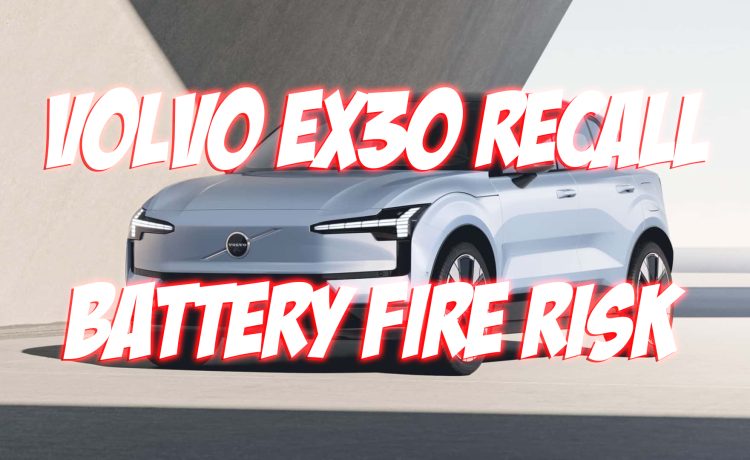
Volvo has announced the recall of its compact EX30 SUVs, for a number of approximately 40,000 units, to correct a safety problem in relation to the high-voltage battery packs. It will involve the company replacing modules in the affected model free of charge during the recall that had not been recalled earlier. This danger of the battery cells overheating and potentially erupting into fire cuts across 40,323 vehicles overall, comprising the EX30 Single-Motor Extended Range and the Twin-Motor Performance.
The cause of the problem is the high-voltage cells offered by Shandong Geely Sunwoda Power Battery Co., a joint venture backed by Geely, that is, the parent company of Volvo. Volvo has ensured that the supplier has discovered the issue, remedied the issue and shall supply new battery cells to complete the recall.
The recall is part of a 1.9 billion cost-cutting program that Volvo undertakes to simplify its operations and integrate further with Geely. The announcement had also been accompanied by a 4% decline in the share price of Volvo cars, as investors had worries on the financial side of the recall and the overall restructuring process.
In a series of markets, Volvo has been informing owners that they should take precautions by parking their cars in open spaces and only charging to 70 percent since December. It replied to the fault by saying it would replace the affected battery modules at no cost and that the problem could be linked to the manufacturing fault of the power cells.
The move by Volvo to do what is right as early as possible highlights the fact that the company values safety and is not unwilling to incur the expense of fixing the flaw. The company has committed itself to collaborating with the joint venture as it seeks to have all new batteries installed in future cars that have strict safety standards. Volvo’s head of product safety, in a statement, made it clear that the recall was a precautionary measure that would help in preventing any possible fire incidents and also keep the brand’s reputation of being reliable.
According to industry observers, the recall is another item in an increasingly long list of high-profile battery-related incidents, which have led regulators as well as automakers to take a closer look at supply chains and manufacturing processes. Although the recall of Volvo does not cover a large number of cars compared to certain previous cases, the active stance of the company can help it overcome the reputational losses and make customers trust their electric models.
With the progress of the recall, Volvo is likely to inform owners of the situation with replacement delivery and other safety measures. The car manufacturer has also reiterated its transparency by assuring to report periodically through its legitimate channels. It is possible to draw the lesson that the recall has shown that no matter how high the level of technology is, vigilance and immediate reaction have become inseparable items in switching to electric mobility.
Source: Reuters.com