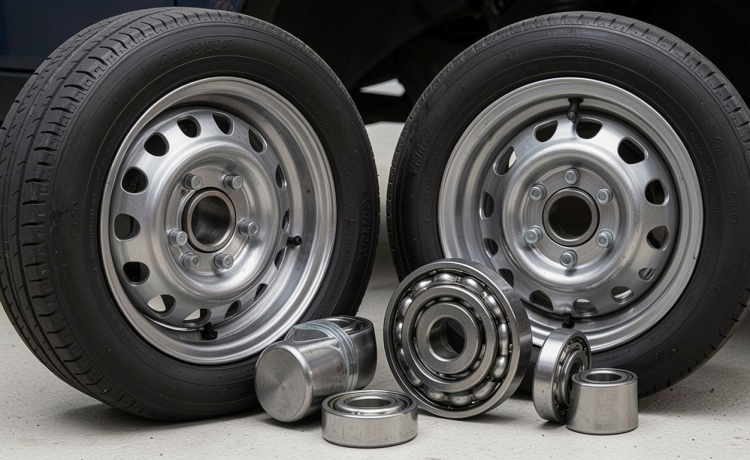
“There’s a hum from the front of the car that gets louder above 40, and my mechanic said it’d fail inspection but I want to know if that’s actually true.” That question shows up before someone’s annual safety inspection every week on car forums. The honest answer is, it depends on the state and how bad the bearing is. A bearing that hums under cruise but holds the wheel firm at idle is a different conversation than one that lets the wheel rock when an inspector grabs it at 9 and 3.
Wheel bearings sit in a strange gray zone. They’re not on every state’s checklist by name, but they ARE on the lift test every real inspection runs.
What inspectors actually check (and what they ignore)
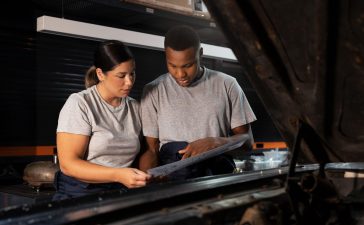
Inspectors check for lateral and vertical play in the wheel, not noise. The tech lifts the car, grabs each front wheel at 12-and-6 and then at 9-and-3, and rocks it. Any movement that isn’t traceable to a tie rod or ball joint gets traced to the hub bearing. If it moves, you fail.
The online guess of “they’ll hear the hum during the road test” is wrong. Most state inspections don’t include a road test. PA doesn’t require one for passenger cars. The inspector spends 30 seconds per wheel on the lift and that’s it. Plenty of cars pass with a noisy bearing the owner has been ignoring for six months. The fact that it’s about to seize is not the inspector’s problem, that day.
Knowing the realistic wheel bearing replacement cost ahead of time is the difference between walking in with a number in your head and walking in cold. For a front hub assembly on most domestic SUVs and pickups, parts run $80 to $250, labor adds $150 to $400, and you’re out the door for under $700 per wheel. Rear press-fit bearings can run higher.
The symptoms most people describe before they get the diagnosis
The most common giveaway is a hum that gets louder with speed and changes pitch when you change lanes. People describe it as “sounds like an airplane taking off.” The lane-change test is the home version of the inspector’s lift test. If the hum gets louder leaning into a left turn, the right bearing is loaded. Left turn loads the right wheel. Counterintuitive but true.
Other tells:
- Hum changes pitch with speed but not with engine RPM. Rules out driveline noise.
- Slight wobble in the steering wheel above 60.
- ABS light kicks on intermittently, because some hubs have the wheel speed sensor built in.
- Grinding feel through the floor on hard braking. More advanced.
A 2014 Honda Pilot with 110,000 miles came through last spring. Owner heard a growl on the highway for months, assumed tires, rotated them twice. PA inspection failed it on the right front, 3mm of play at 9-and-3. Hub assembly plus labor: $540. Tires were fine.
State-by-state inspection rules
State inspection rules on wheel bearings vary more than people think, here’s the short version for the states that actually do safety inspections.
- Pennsylvania: Annual safety inspection. Play test on the lift. Measurable lateral play = automatic fail. One of the strictest.
- New York: Annual safety inspection. Same play test. Humming alone usually won’t fail. Play will.
- New Jersey: No safety inspection on passenger cars since 2010. Emissions only. A bad bearing won’t fail you in NJ.
- Texas: Safety inspection in most counties (being phased out for non-commercial in 2025). Wheel play included.
- North Carolina: Annual safety inspection. Hub play test is on the checklist.
- Virginia: Annual safety inspection, also strict. Bearing play is grounds for rejection.
If you’re in California, the Midwest, or any no-inspection state, the only “test” your bearing has to pass is your willingness to keep driving on it. Which you shouldn’t. A bearing that fails completely can lock a wheel or let it leave the car. That’s the reason these tests exist.
What the repair actually costs, and where shops mark it up
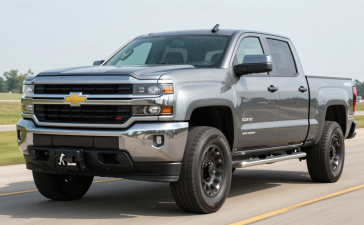
A front hub bearing replacement runs $300 to $700 per wheel at an independent, $600 to $1,200 at a dealer. The part itself, a sealed hub assembly for a Silverado, Pilot, or Camry, is $80 to $250.
Where shops mark up: the alignment they tell you you need afterward (a hub replacement does not require one unless they touched the suspension), and the “while we’re in there” sell on the other side. If the other side is quiet, skip it. Bearings fail one at a time.
Press-fit rear bearings (older Civics, some BMWs) run $500 to $900. And if you’ve read about how a class-action settlement plays out for a defective part, the reverse applies here. You have no recourse on a bearing failure outside warranty. Wear-and-tear.
What to do if you fail (or are about to)
Get a second opinion before you authorize the repair, especially at a dealer. A tech can confirm a bad bearing in two minutes on a lift. If a shop fails you on inspection and you doubt the call, most states give a 15 to 30 day re-inspection window where you come back with the repair done and don’t pay again. Read your rejection slip.
And while you’re cross-checking what a shop says about other warning lights at the same visit, breakdowns like this one on the Audi EPC light are useful for separating “drive home carefully” from “tow it.” Same logic on bearings. Faint hum, drive it. Grinding-with-wobble, tow it.
Can You Fail State Inspection for a Bad Wheel Bearing – FAQs
Will a humming wheel bearing fail state inspection?
A humming wheel bearing won’t always fail state inspection, because most programs test for wheel play, not noise. PA, NY, TX, NC, and VA all use the lift-and-rock test. If the bearing hums but the wheel doesn’t move at 9-and-3, you usually pass. Once it develops play, you fail.
How much does wheel bearing replacement actually cost?
Wheel bearing replacement costs $300 to $700 per wheel at an independent for a front hub assembly, and $600 to $1,200 at a dealer. The part is $80 to $250 for most common vehicles. Don’t let a shop talk you into doing both sides if only one is bad, bearings fail one at a time.
How long can I drive on a bad wheel bearing?
You can drive on a bad wheel bearing for weeks if it’s just humming, but you shouldn’t push it once you feel wobble, grinding, or heat off the wheel after a drive. A fully failed bearing can lock the wheel. The safe window is “until you can get it into a shop,” not “until your inspection is due next year.”